



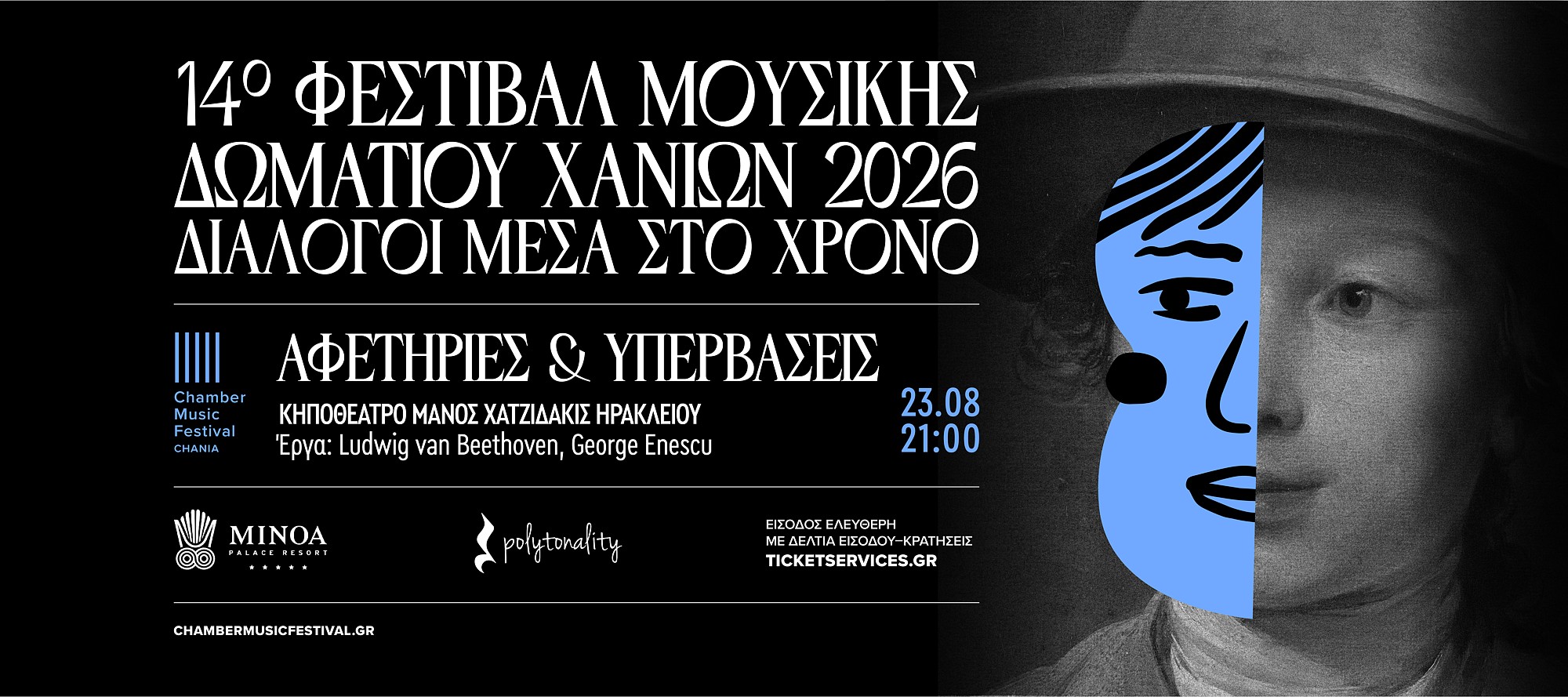
CHAMBER MUSIC FESTIVAL 2026
Concert
Avant Premiere
Sun 23.8
CHAMBER MUSIC FESTIVAL 2026
The restrained and unadorned use of simple musical motifs and only three instruments can, in the hands of a musical “architect” such as Beethoven, create an entire world of astonishing clarity, embodying the purest ideal of Beauty. Approximately a century later, one of the greatest musical talents of all time, the Romanian violinist and composer George Enescu, surrenders himself to the warm sonority of eight string instruments and, through a style of writing that is profoundly Romantic, harmonically adventurous and rich in color, undertakes a personal act of transcendence—reaching toward the metaphysical while remaining earthly and sensual.
Leading string soloists, well known to the audience of the Chamber Music Festival Chania through their many successful appearances in recent years, place their acclaimed artistry at the service of two masterpieces that stand at opposite aesthetic poles.
Sunday, August 23th, 2026, 21:00 – Heraklion Garden Theater
THE CONCERT IN HERAKLION IS PART OF THE CRETE FESTIVAL & CO-ORGANIZED AND SUPPORTED BY THE REGION OF CRETE
Ludwig van Beethoven (1770–1827) - Trio for Violin, Viola and Cello in G major, Op. 9 No. 1 (1797–1798)
George Enescu (1881–1955) - Octet for Strings in C major, Op. 7 (1900)
Book your tickets
Safely book your tickets online
Avant Premiere arrow_forward1st Concert: Origins & Transcendence arrow_forward
2nd Concert: Emotion & Lyricism Across Centuries arrow_forward
3rd Concert: Intimacy & Universality arrow_forward
4th Concert: Contrasts & Convergences arrow_forward
5th Concert: Tension & Balance arrow_forward
6th Concert: Tradition & Memory arrow_forward
Special 4-Day Pass arrow_forward
Book your tickets
- Online at ticketservices.grarrow_forward
Concert
Works
CHAMBER MUSIC FESTIVAL 2026

Ludwig van Beethoven (1770–1827)
Trio for Violin, Viola and Cello in G major, Op. 9 No. 1 (1797–1798)
1. Adagio – Allegro con brio
2. Adagio ma non tanto e cantabile
3. Scherzo: Allegro – Trio I – Trio II
4. Presto
The Trio for violin, viola and cello in G major is the first of the three Trios that together make up Ludwig van Beethoven’s Op. 9, but at the same time it is his third work for string trio; the first Trio, Op. 3, is essentially a Divertimento in six movements, while the second Trio, Op. 8, is called (and indeed is) a Serenade, also in six movements. It is remarkable that so early in his life and career the composer wrote a total of five works for string trio, whereas after these he never again returned to composing a work of this kind. This fact becomes even more interesting if one considers that the string trio was by no means a popular genre in late-18th-century Vienna – unlike the string quartet. Beethoven certainly treated these works as compositional “essays” before he felt ready to turn to quartets and devote himself to composing quartets for the rest of his life, leaving his indelible mark on the genre and undoubtedly giving it some of the most inspired pages of his music.
Also noteworthy is the fact that the three Trios of Op. 9 present virtuosic demands (particularly in the violin part) that clearly exceed the abilities of Vienna’s amateur music lovers of the time – and this clearly demonstrates Beethoven’s determination to remain uncompromising in his artistic vision and not to deviate from it in the slightest out of consideration for the commercial appeal of his music. Nevertheless, when the Trios were first published in 1798, the part for each instrument was issued separately rather than as a complete score of each work, with the result that one could not form a complete picture of the composer’s vision unless one heard one of the Trios performed live. This also helps to explain why they did not enjoy particular popularity in their own time, although Beethoven himself maintained that, up to the time of their composition, they were his most accomplished works! They were dedicated to Count Johann Georg von Browne, one of the composer’s patrons and supporters during his youth – and Beethoven also dedicated to the Count’s wife the three Piano Sonatas, Op. 10, written at approximately the same period of his life. The first Trio of Op. 9 remains to this day the most popular and frequently performed of the three, a genuine musical “gem” that strikingly demonstrates the composer’s extraordinary talent, his exquisite instrumental writing, the unwavering architectural construction of his music, as well as his desire to stir the “stagnant waters” of music and create music of unprecedented power and dramatic intensity by the standards of his time.



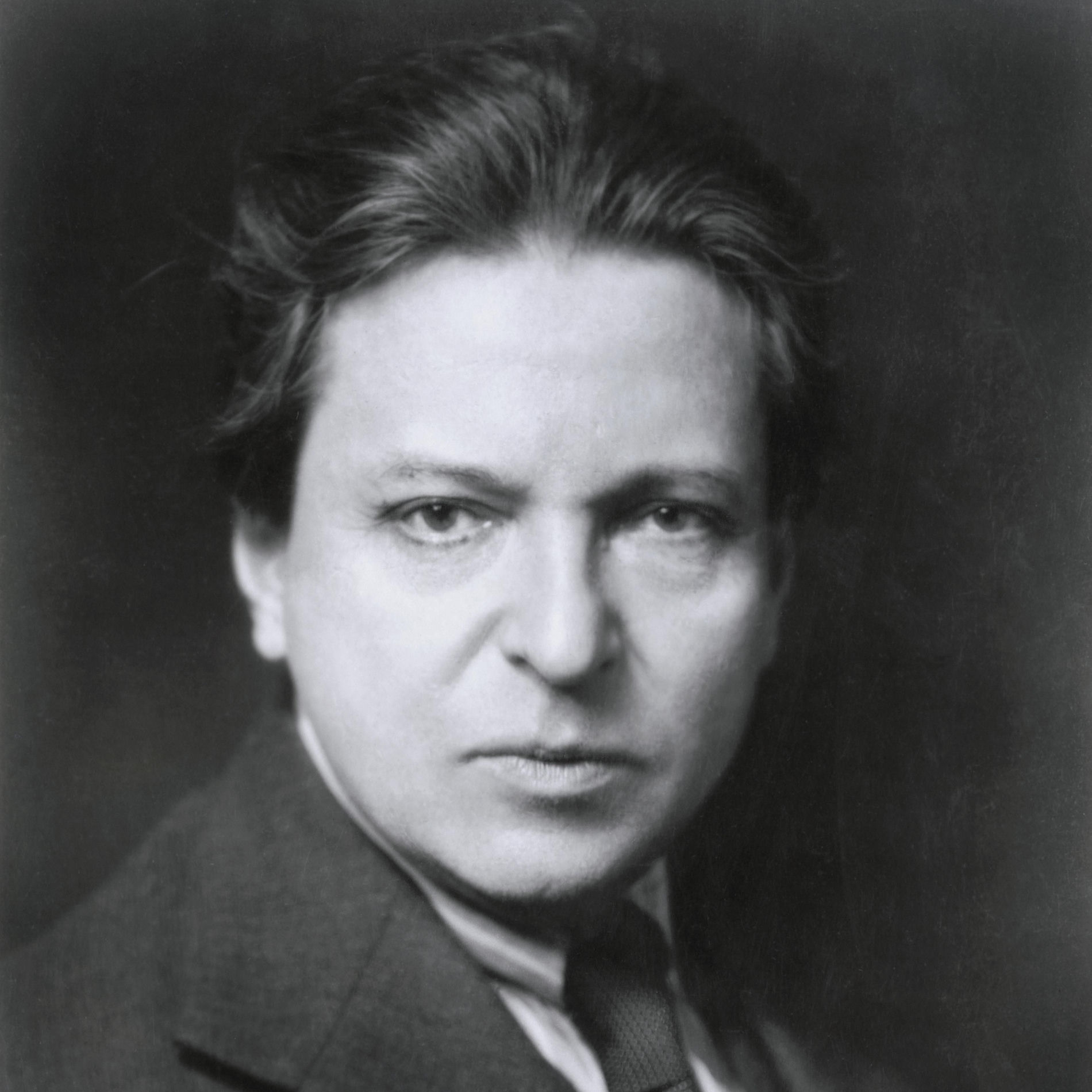
George Enescu (1881–1955)
Octet for Strings in C major, Op. 7 (1900)
The Romanian George Enescu was a child prodigy of almost inconceivable accomplishments that remain astonishing to this day: he began playing the violin at the age of four and very quickly acquired remarkable virtuosity; at five he was already signing his first compositions; he was the youngest student in the history of the Vienna Conservatory (he was admitted at the age of seven and graduated at thirteen); and he rapidly developed into one of the greatest violinists of all time, as well as a conductor and composer of exceptional qualities, while at the same time playing the piano with the ease one would expect from a professional virtuoso. It is true, however, that he regarded himself, first and foremost and above all his other capacities, as a composer. And one of the first works of his maturity was his Octet for Strings, which required approximately a year and a half of work and was completed in 1900, when he was only 19 years old.
Enescu himself described the anxiety he felt as he had set himself the challenge of writing a four-movement work of epic proportions, while naturally also bearing the “weight” of Felix Mendelssohn’s masterpiece, the Octet, written for the same instrumental forces, saying that he felt like an engineer called upon to build his first enormous bridge over a river! The composer aspired to secure the premiere of his work in Paris as part of the prestigious “Concerts Colonne” of the time, but his music seemed too complicated to the performers, with the result that the premiere was delayed and eventually took place in December 1909. In the meantime, through the intervention of Enescu’s beloved teacher at the Paris Conservatoire, André Gedalge, the Octet had been published (1905), and the composer gratefully dedicated the work to his teacher.
The Octet is a far more mature work than one would expect from such a young composer: its harmonic language is deeply Romantic, and one senses the influences of Richard Wagner, Gustav Mahler and Richard Strauss, while touches of the colour of the traditional music of Romania and Eastern Europe in general are also present. But the most impressive element of the work is undoubtedly the architecture linking its four movements, which owes much to Franz Liszt’s technique of “thematic transformation”: the motivic or thematic elements that appear in the first movement of the Octet reappear in the subsequent movements, developed or transformed in the most imaginative ways, creating a sense of profound cohesion between the different chapters of the musical narrative. To this end, the four movements are performed – in accordance with Enescu’s instructions – without interruption, while he himself acknowledged that his intention was for all the movements together to be understood as a single musical journey, following the structure of a large-scale Sonata form. Thus, both the intellectually conceived overall structure of the Octet and the abundance of emotional states that appear kaleidoscopically within it create a work that is rightly considered one of the most imposing pinnacles of the Romantic chamber-music repertoire.