



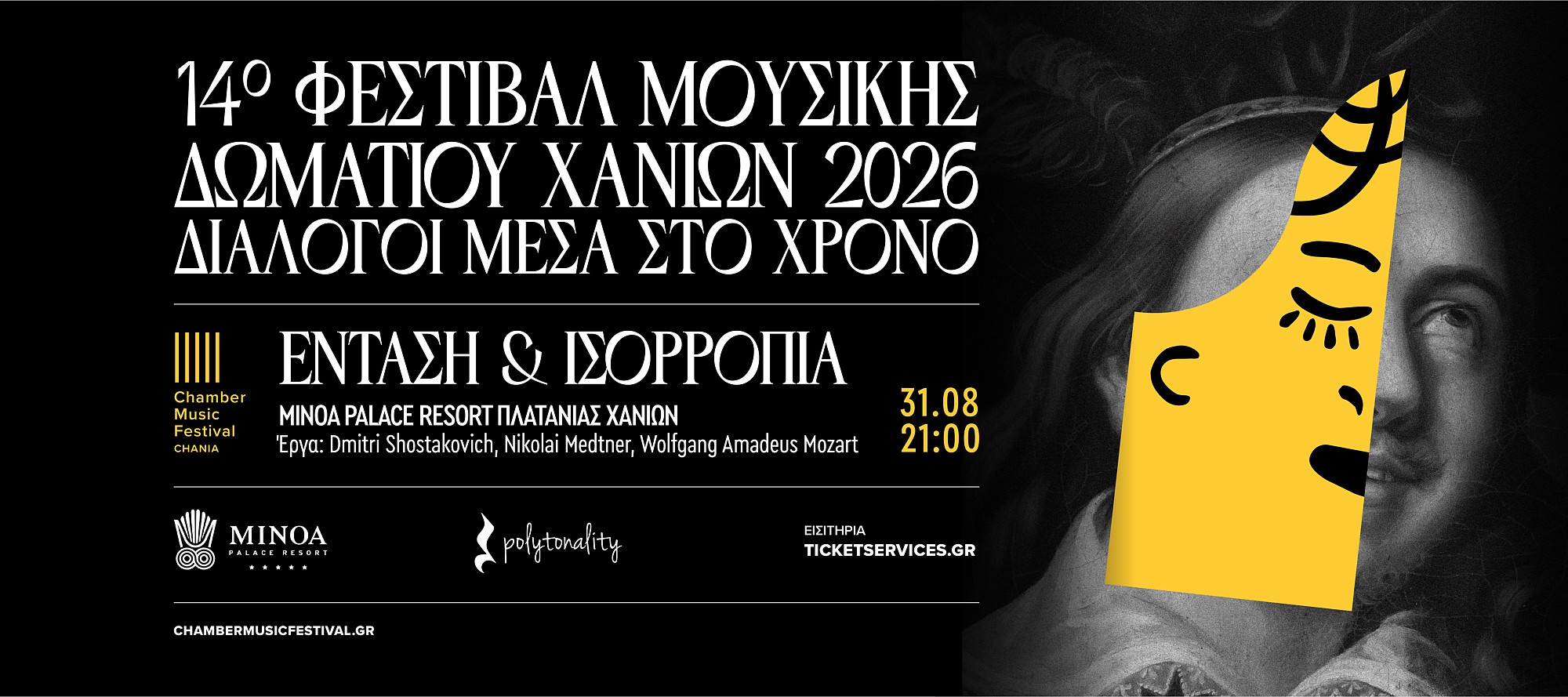
CHAMBER MUSIC FESTIVAL 2026
5th Concert
5th Concert: Tension & Balance
Mon 31.8
CHAMBER MUSIC FESTIVAL 2026
Throughout the centuries, art music has been realized as an unending struggle between tension and relaxation, between dissonance and consonance, between the spiritual and the material. Musical beauty is never one-dimensional; rather, it is understood as the achievement of balance between opposing forces.
This balance is attained in the most natural and effortless way in Mozart’s music, and the five distinguished musicians performing his Quintet undoubtedly possess all the qualities required to do justice to this perfection of equilibrium. At other times, however, such balance is achieved through more anxious means, through feverish expression and powerful conflict, as in the emotionally charged music of Dmitri Shostakovich or the nostalgically Romantic world of his compatriot Nikolai Medtner. A profound interpreter of both composers, the virtuoso Alim Beisembayev returns to the Chamber Music Festival Chania for a second consecutive year.
Claude Debussy (1862 – 1918) - Images – Livre 1
Wolfgang Amadeus Mozart (1756–1791) - String Quintet in E-flat major, K.614 (1791)
Dmitri Shostakovich (1906–1975) - Piano Trio No. 2 in E minor, Op. 67 (1944)
Book your tickets
Safely book your tickets online
Wounds & Lamentations [80 years since the end of World War II – 50 years since the death of Dmitri Shostakovich] arrow_forward1st Concert: Origins & Transcendence arrow_forward
2nd Concert: Emotion & Lyricism Across Centuries arrow_forward
4th Concert: Contrasts & Convergences arrow_forward
5th Concert: Tension & Balance arrow_forward
6th Concert: Tradition & Memory arrow_forward
Special 4-Day Pass arrow_forward
Book your tickets
- Online at ticketservices.grarrow_forward
Concert
Works
CHAMBER MUSIC FESTIVAL 2026

Claude Debussy (1862 – 1918)
Images – Livre 1
1. "Reflets dans l'eau" (Reflections in the water) in D-flat major
2. "Hommage à Rameau" (Tribute to Rameau) in G-sharp minor
3. "Mouvement" (Movement) in C major
Incubated in Impressionism in the visual arts and the Symbolist movement in literature, Debussy was alert to the intoxicating interplay of words and images. “I am almost as fond of pictures as I am of music,” he wrote. He composed three sets of musical Images, the two for piano and another for orchestra. In lieu of a visual stimulus, Debussy deployed carefully wrought titles, by turns evocative and enigmatic, to stimulate the imaginations of his listeners.
“Reflets dans l’eau” (Reflections on the water) is a masterpiece in the tradition of water music, the piano conjuring up water both at rest and at play, deep and mysterious, and glinting in sunshine. “Hommage à Rameau” borrows no stylistic trait from Jean-Phillipe Rameau (1683-1764), Debussy’s composer predecessor. At the time he was composing his first set of Images in 1903, Debussy was editing some of Rameau’s music. Does the melancholy of the piece describe the hypnotic allure of a remote and possibly unknowable past? “Mouvement” explains itself. The performer is asked to play with “a whimsical lightness, but precisely.”
Source: LAPhil


Wolfgang Amadeus Mozart (1756–1791)
String Quintet in E-flat major, K.614 (1791)
1. Allegro di molto
2. Andante
3. Menuetto: Allegretto – Trio
4. Allegro
Although Wolfgang Amadeus Mozart’s String Quintets (two violins, two violas and cello) never achieved the prominence of his mature symphonies or his concertos (and certainly not that of his great operas), the fact remains that they constitute some of the finest examples of his instrumental writing, capable of illuminating with unique clarity the most intimate aspects of his musical and, by extension, emotional universe. The last two of them, in D major (K. 593) and E-flat major (K. 614) respectively, were written within the space of a few months: the first in December 1790 and the second in April 1791, approximately eight months before his death, thus constituting the Austrian Classical composer’s last major chamber-music work. Both Quintets were published in 1793, that is, after the composer’s death; on the basis of historical evidence, researchers consider it quite possible (although it has by no means been confirmed) that they were written following a commission from Johann Tost, a leading violinist in Josef Haydn’s orchestra at the court of Count Esterházy, originally from Moravia, who had become a successful and wealthy businessman and was in Vienna at the time they were composed – after all, it was rather unusual for Mozart to write a work without anticipating some financial income from it.
A characteristic motif reminiscent of a “hunting call” in the violas opens the first movement of the work – and reminds us of Mozart’s particular fondness for the viola, an instrument he himself played as a member of quartets during the years he lived in Vienna. Nevertheless, maintaining the “balance,” the more lyrical second theme of the movement is presented by the first violin and subsequently by the cello (although in the recapitulation section this role is taken over by the first viola). Some have regarded the first movement of Josef Haydn’s Symphony No. 67 as the stylistic model for the first movement of the Quintet; correspondingly, the slow movement of Symphony No. 85 (again by Haydn) has been considered a model for the Quintet’s slow movement, a set of four variations on a majestic theme in a style and rhythm reminiscent of the old Gavotte dance. The Menuetto that follows combines Viennese aristocratic elegance and grace with elements of “pastoral” idyllic charm. The movement, however, that is generally acknowledged to be closest to Haydn’s spirit, to his “sardonic” humour, playful vitality and inexhaustible inventiveness in the development of his thematic ideas, is the finale: there is general agreement that this movement displays significant (and therefore certainly not coincidental) similarities to the finale of a quartet (also in E-flat major) that Haydn had composed only a few months earlier and had published as the sixth quartet of his Op. 64. In short, the entire Quintet is a genuinely radiant work, unadorned yet adventurous, joyful yet extraordinarily profound.




Dmitri Shostakovich (1906–1975)
Piano Trio No. 2 in E minor, Op. 67 (1944)
1. Andante – Moderato
2. Allegro con brio
3. Largo –
4. Allegretto – Adagio
Ivan Ivanovich Sollertinsky (1902–1944), a close friend and mentor of Dmitri Shostakovich, was a multifaceted figure in Soviet letters and the arts: he distinguished himself in his time as a musicologist and music critic, served as artistic director of the Leningrad Philharmonic, and also successfully immersed himself in many other fields (theatre, literature, linguistics, history). The news of Sollertinsky’s sudden and premature death in February 1944 reached Shostakovich while he was composing the first movement of a Piano Trio; the work was completed in the summer of that year and dedicated to the memory of the Russian scholar.
Beyond the Trio’s mournful character in response to the death of a beloved friend and important intellectual, its extensive finale contains strong elements of Jewish traditional music. This can be explained, on the one hand, if one considers that at the time the work was written the Holocaust, in all its tragic dimensions, was becoming increasingly known in the Soviet Union and, on the other, by the composer’s sincere appreciation of Jewish music. Much later, he characteristically noted: “… Jewish traditional music made the greatest impression on me. It is music with many faces: it can appear joyful while being tragic. It is almost always laughter through tears. This quality of it is very close to my own idea of how music should function.”
Unlike the great Romantic Trios of the 19th century, in the overwhelming majority of which the piano predominates with rich, spectacular writing, Shostakovich treats the piano more sparingly (on many occasions the pianist plays with the two hands an octave or more apart), with the aim of having it proceed alongside the violin and cello as an equal rather than in a dominant role. The first movement opens with the cello playing alone in harmonics and thus sounding, in practice, higher than the other two instruments, which subsequently enter in succession. The main section, moderately fast, is written in sonata form and in a rather “Neoclassical” style, without passionate outbursts but with restraint and an inclination towards a melancholy mood. By contrast, the following brief scherzo unfolds in a manic manner, like a frenzied waltz – according to many, the movement constitutes a musical “portrait” of Sollertinsky’s exuberant personality.
The slow movement opens with the piano playing eight resonant chords, which are repeated unchanged six times; over this fixed harmonic background, the violin and cello unfold a long lament, harrowingly expressive. It is by no means coincidental that this movement was played in 1975 during the public lying-in-state of the composer’s body in the Great Hall of the Moscow Conservatory. The development of the dance themes in the finale, as mentioned above, is carried out in such a way as to give them something of the character of a “dance of death” (danse macabre). The long epilogue brings back thematic elements from the first and third movements, and the music gradually fades away, preserving an ambiguity between resignation and hope…