




CHAMBER MUSIC FESTIVAL 2026
6th Concert
6th Concert: Tradition & Memory
Thu 3.9
CHAMBER MUSIC FESTIVAL 2026
THESE CONCERTS AT ANCIENT APTERA FORM PART OF THE FESTIVAL OF CRETE, CO-ORGANIZED WITH THE REGION OF CRETE AND THE EPHORATE OF ANTIQUITIES OF CHANIA
Free admission with entry passes
The closing concerts of the Chamber Music Festival Chania at the Theatre of Ancient Aptera have, in recent years, become a successful institution and a symbol of the ability of classical music to speak to every person, regardless of place or time.
This year, once again, the Festival welcomes its loyal audience to this historic and idyllic setting, presenting works of exceptional significance and beauty. The indefatigable violinist Giorgos Demertzis, one of the cornerstones not only of the Festival but of Greek musical life as a whole, performs the Sonata for Solo Violin by Nikos Skalkottas, the greatest Greek composer of the twentieth century, whose music was brought to wider public attention to a considerable extent through Demertzis’s performances and recordings.
The Festival then promises a dazzling interpretation of Kodály’s Duo, while the concert—and, by extension, the entire Festival—concludes with a beloved work by a beloved composer: the magnificent String Quintet No. 2 by the great German Romantic Johannes Brahms.
Nikos Skalkottas (1904–1949) - Sonata for Solo Violin (1925)
Zoltán Kodály (1882–1967) - Duo for Violin and Cello, Op. 7 (1914)
Johannes Brahms (1833–1897) - String Quintet No. 2 in G major, Op. 111 (1890)
Book your tickets
Safely book your tickets online
Wounds & Lamentations [80 years since the end of World War II – 50 years since the death of Dmitri Shostakovich] arrow_forward1st Concert: Origins & Transcendence arrow_forward
2nd Concert: Emotion & Lyricism Across Centuries arrow_forward
3rd Concert: Intimacy & Universality arrow_forward
4th Concert: Contrasts & Convergences arrow_forward
5th Concert: Tension & Balance arrow_forward
6th Concert: Tradition & Memory arrow_forward
Special 4-Day Pass arrow_forward
Book your tickets
- Online at ticketservices.grarrow_forward
Concert
Works
CHAMBER MUSIC FESTIVAL 2026

Nikos Skalkottas (1904–1949)
Sonata for Solo Violin (1925)
1. Allegro furioso
2. Adagietto
3. Allegro ritmato
4. Adagio quasi Recitativo
Nikos Skalkottas (1904–1949), perhaps the most important and internationally best-known Greek “classical” composer, is undoubtedly better known for his turbulent and short life than for his work as a performing and recorded legacy. The Sonata for Solo Violin (1925) is considered his first “mature” work among those that have come down to us from the period of his studies in Berlin, initially as a violinist and, very soon afterwards, as a composer. It was a gift to his friend, the violinist Nelly Askitopoulou, thanks to whom the work was preserved, unlike many others from that period.
Long before joining Arnold Schönberg’s class, the composer and violinist displayed with unique mastery his ability to work with a twelve-note series, creating motifs with direct references to jazz, to the entertainment music of Berlin at that time, but also to Greek folk music (long before the systematic documentation he would undertake in the 1930s), to the Epirote lament (at the beginning and end of the fourth movement), or to a fugue (a direct reference to the work of Bach). The Sonata has four movements of strongly contrasting character: the highly dynamic first movement contains clear references to the entertainment music of Berlin, in which Skalkottas would participate as a violinist and composer in order to earn a living, with strong and unmistakable elements of jazz. The second movement is an elegy, while the scherzo that follows could be understood as an imaginary Greek dance. The distinctive fourth movement is a fugue that ends in an orgiastic delirium, enclosed within an Epirote lament… and all of this through the working-out of a series of notes that he presents at the beginning of the first movement like a simple scale.
Following the work’s dissemination through recordings in the final years of the 20th century and the appearance of a published edition, indeed a critically revised one – a unique distinction for a Greek work – it met with a particularly warm reception from audiences, critics and, above all, violinists, who found in it a unique companion within the highly interesting 20th-century repertoire for solo violin alongside comparable works by Hindemith, Bartók, Prokofiev or Ysaÿe.
Giorgos Demertzis

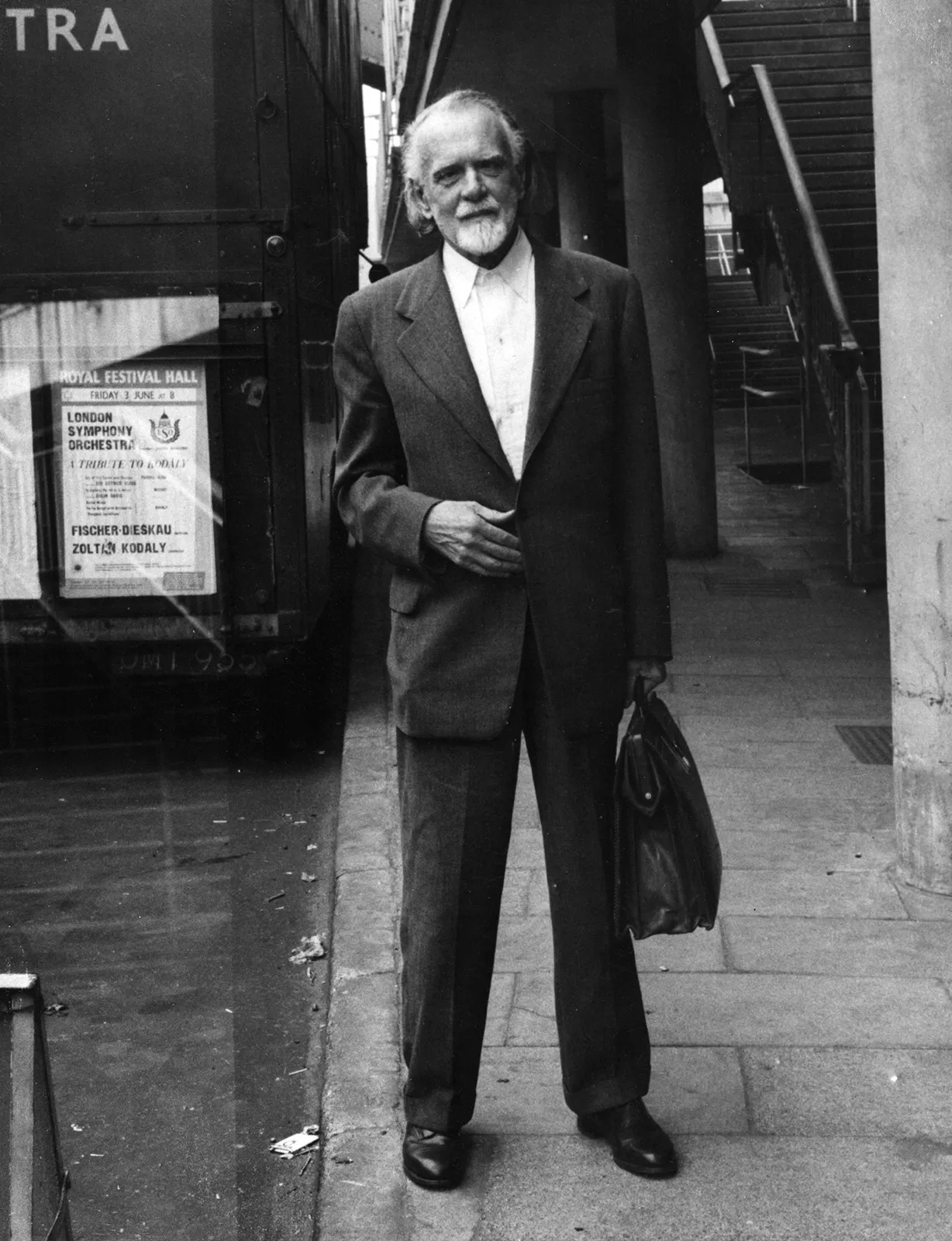
Zoltán Kodály (1882–1967)
Duo for Violin and Cello, Op. 7 (1914)
1. Allegro serioso, non troppo
2. Adagio – Andante – Tempo I
3. Maestoso e largamente, ma non troppo lento – Presto
A versatile and multifaceted leading figure in Hungary’s musical life during the first half of the 20th century, together with his compatriot and kindred musical spirit Béla Bartók, Zoltán Kodály studied the traditional music of his homeland in depth and, through his compositional work, successfully sought to unite traditional and art-music elements, particularly as the latter had developed in late Romanticism and Impressionism. Possessing both broad familiarity with the world of instrumental music from his youth (as a child he had studied string instruments and piano) and a deep love of vocal music, he developed not only into an imaginative composer but also into a profound scholar and an active academic teacher, who influenced numerous later musicians in his country.
The Duo for Violin and Cello is a relatively early work by the composer, written in 1914, at the time when the First World War was breaking out. Having already devoted himself extensively to the study of traditional Hungarian music, and having travelled to Berlin and Paris, journeys that broadened his musical horizons, Kodály wrote the work in complete accordance with the view he expressed at the time, namely that “the works of art that exert the strongest influence are those that express with the greatest completeness the national characteristics of their creator.” The instrumental writing is, as expected, impressively accomplished, and a continuous dialogue unfolds between the two instruments, at times dynamic and at times more restrained, sometimes with violin and cello moving together and at other times coming into conflict. The first movement is written in sonata form with two principal themes, presented by the cello and violin respectively. The slow movement is clearly darker and more sombre – according to some scholars, its bleak atmosphere is connected with the outbreak of the Great War. A long, rhapsodic monologue by the violin opens the finale, which subsequently develops into a series of dance episodes of great speed and unflagging energy.


Johannes Brahms (1833–1897)
String Quintet No. 2 in G major, Op. 111 (1890)
“All my life I have worked hard; now, for the first time, I am really going to be lazy!” This is what Johannes Brahms declared in the summer of 1890, during the period in which he was writing his Second String Quintet. Indeed, for a (rather brief) period, the composer intended this work to bring his glorious compositional career to a close – and so, in his mind, the Quintet appeared, at least for a moment, to be his “swan song,” something fully in keeping with the astonishing quality, variety and maturity of its writing. When the composer sent the handwritten score of the Quintet to his publisher, he stated explicitly that this would be his final work and that the time had come for him to retire from active creative life; this, however, was not to happen, since shortly afterwards, inspired by the artistry of the German clarinettist Richard Mühlfeld, he would compose a series of masterpieces featuring the clarinet (the Clarinet Trio and Quintet, as well as the two Sonatas for clarinet and piano), together with a series of collections of piano pieces (Opp. 116, 117, 118 and 119).
Historical research into the genesis of the Second Quintet suggests that Brahms’s original idea was to write a symphony, although he soon abandoned this plan and turned instead towards chamber music. Like the First String Quintet, Op. 88, written in 1882, the German Romantic composer’s Second String Quintet is scored for two violins, two violas and one cello, following the model of earlier comparable works by Mozart. And the fact that the composer preferred to write the work for two violas (rather than two cellos) fits perfectly with the affection he would show for the clarinet only a few months later – after all, in his works for clarinet he himself provided the viola as an “alternative” instrument in place of the clarinet, since it occupies a similar register and possesses a related timbre.
Brahms’s Austrian friend and first detailed biographer, Max Kalbeck, perceptively observed that the Second Quintet combines “German humour and Slavic melancholy, Italian vivacity and Hungarian pride.” Listening to the work bears him out, since all of these elements permeate its music, as though Brahms intended to capture through music the atmosphere of cosmopolitan Vienna of his time, which had, after all, been his home for the greater part of his creative life. Apart from the first movement, which is characterised by symphonic grandeur (in its first principal theme) and Viennese grace (in the second), several musical elements of Slavic character appear in the three subsequent movements. For example, the slow movement contains abundant elements from the popular music of the Hungarian Roma, unfolding as a series of free variations on a rather unusual theme. The scherzo that follows alternates elements of the traditional Austrian dance, the Ländler, with the charm of the Viennese waltz, while the brilliant finale is constructed in an elaborate sonata-rondo form, often oscillating between the (unexpected) key of B minor and G major – with the latter ultimately prevailing in the impressive, Hungarian-style concluding section.
